

Tech Challenge Spotlight: INFN8 VZN
For our spring Tech Challenge, we sought AI-native technologies that form the building blocks of a cognitive water ecosystem. Our program sponsors, Badger Meter, Watts Water Technologies and Xylem, were so impressed with the mission of Canadian nonprofit INFN8 VZN that they decided to award a special “global impact spotlight” to the organization. Learn more about INFN8 VZN in this Q&A with Executive Director Teqami Griffith.
What is the mission of INFN8 VZN?

Teqami Griffith, co-founder and executive director
INFN8 VZN exists to physically remediate mercury, cadmium, arsenic and lead contamination caused by the deliberate use of mercury as a chemical amalgamation agent in artisanal and small-scale gold mining (ASGM) across Ghana’s affected regions. Decades of unregulated extraction have produced toxic accumulation in river systems, soil and arable land with devastating consequences for surrounding communities. Our mandate is industrial remediation, the restoration of water bodies and land to ecologically viable condition and the institutionalization of mercury-free extraction practices so that remediated sites remain uncontaminated, new mining is conducted without chemical harm to the surrounding environment and exhausted sites are returned to their natural state rather than abandoned as degraded landscapes.
How does AI help you achieve your mission?
INFN8 VZN developed GalaSat 2.2, a proprietary open-source artificial intelligence system built on Google Earth Engine using machine learning. GalaSat 2.2 maps mining disturbance and water turbidity across Ghana’s affected river basins, producing precise assessments of emerging, current and historical contamination that define the full scope of the mission. Seasonal flood patterns and contamination vectors are analyzed in tandem to determine the sequencing of deployment for field teams and equipment. Built on universally accessible infrastructure, GalaSat 2.2 is replicable as a monitoring framework for any ASGM-affected nation.
What are some of the organization’s accomplishments so far?
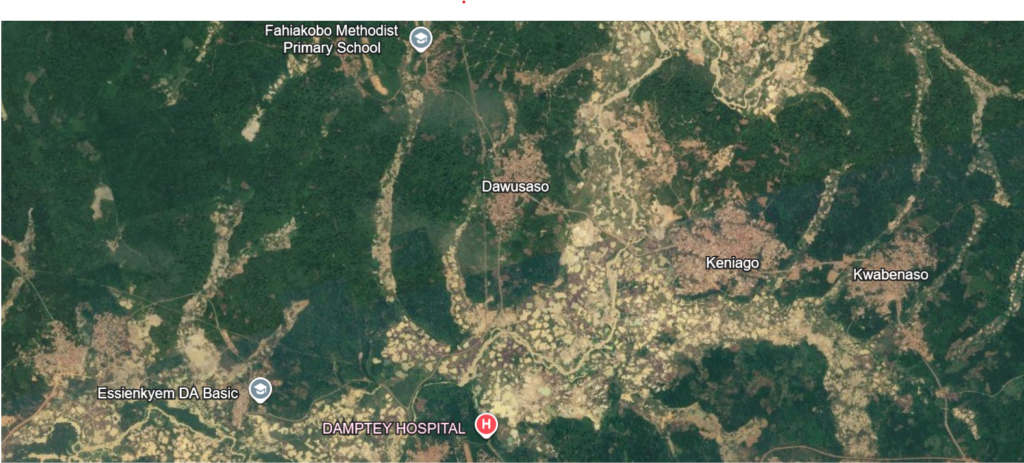
This satellite image of Ghana shows the scale of small-scale gold mining in the region.
Since federally incorporating in November 2025, INFN8 VZN is a confirmed partner of the UNEP Global Mercury Partnership, a member of the Global Waste Cleaning Network, and has received a formal meeting request from the UN Environment Program Global Mercury Partnership Secretariat. GalaSat 2.2, developed entirely by INFN8 VZN, has produced preliminary findings documenting contamination at a magnitude that substantially exceeds Ghana’s official government figures. Across the environmental, medical and diaspora sectors, INFN8 VZN is actively cultivating the institutional partnerships and strategic alliances necessary to execute this mission at the scale it demands.
What are your goals for the future?
INFN8 VZN’s immediate priority is deploying into Ghana’s most critically contaminated regions to execute physical industrial remediation, establish clean water infrastructure for host communities and deliver mercury-free mining training to local practitioners. Land and water remediation must precede medical intervention to prevent recontamination during treatment, a sequencing informed directly by GalaSat 2.2’s contamination vector and seasonal flood analysis. A medical framework encompassing clinical treatment pathways and longitudinal biomonitoring of exposed populations is in development. At the policy level, INFN8 VZN is working toward an enforceable worldwide prohibition on mercury use in ASGM, building the partnerships and alliances required to advance that agenda at every level of the international regulatory landscape.
For more information about INFN8 VZN or to get involved, contact Info@infn8vzn.org.