

Grit & Growth: EMS Industries’ Path to U.S. Success with The Water Council
EMS Industries took its first step toward building a presence in the North American wastewater market at WEFTEC in 2024.
The event confirmed the potential for the company’s proven grit removal pump technology, giving EMS the confidence to establish Grit Removal Solutions (GRS) soon after as a dedicated brand for bringing EMS pump technology into the North American market.
Since that first dip in the water, GRS has built key partnerships after joining The Water Council, using its extensive network to establish a U.S. representative through Mulcahy Shaw Water and open doors with utilities, contractors and industry partners.
GRS has also developed a U.S. supply chain to provide equipment using U.S. materials and suppliers, supporting its long-term ambition to manufacture, supply and install grit removal pump systems for the American market.
“If it wasn’t for The Water Council’s introductions to people on the ground, people who actually listened and said, ‘I think you’ve got something there,’ we probably would have given up by now,” said Joe Meakin, EMS Industries managing director.
About EMS Industries & GRS
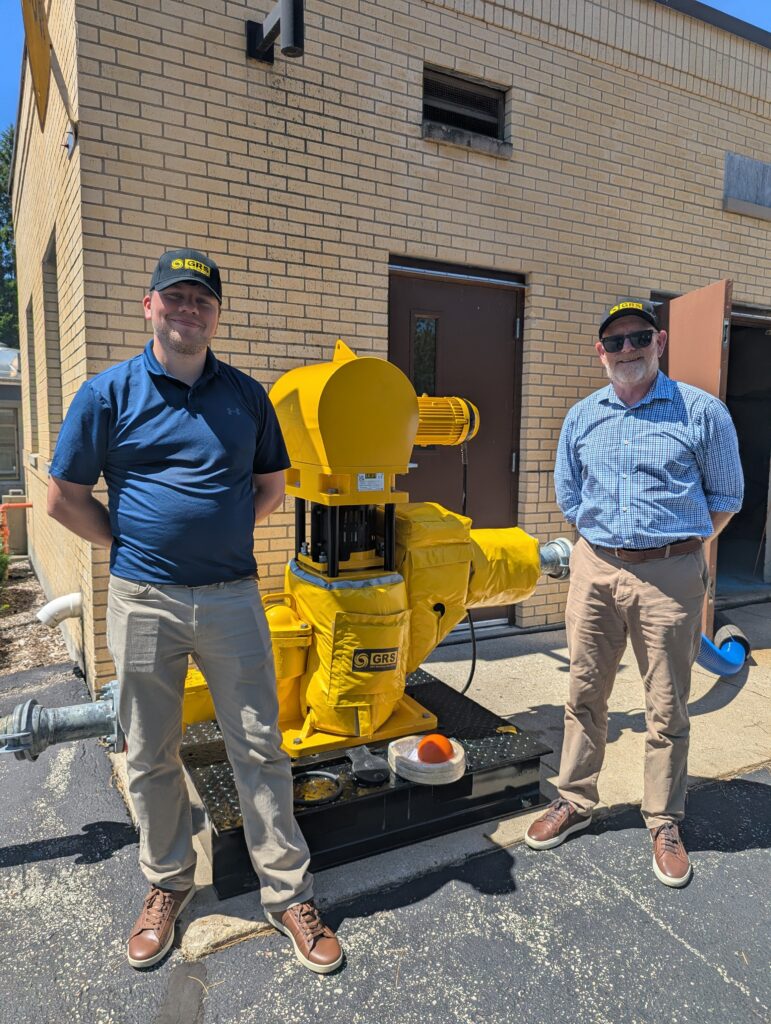
James Murphy and Joe Meakin of EMS Industries demonstrate a GRS pump in Cedarburg, Wis.
EMS Industries has been selling pump solutions for 31 years in 25 countries. Its GRS brand is purpose-built for the removal of grit, or heavy inorganic material such as sand and gravel that can damage equipment further down the line. While most systems remove grit from the bottom of a vortex, GRS pumps pull from the top, increasing performance to 98% removal or higher.
After EMS joined The Water Council in 2025, Executive Director Karen Frost introduced Meakin to Mulcahy Shaw Water, which became GRS’ first sales representative. President Tom Mulcahy was intrigued by this new technology addressing a long-standing problem in the U.S.
“Grit systems have been around a long time, but the way GRS approaches grit removal is unique,” said Tom Mulcahy. “It is a natural fit for the industry and for sites looking to improve how they manage grit in the wastewater process.”
A Successful Pilot
Mulcahy arranged a two-week demonstration of a GRS pump at the Cedarburg Water Recycling Center in southeastern Wisconsin and hired a Milwaukee-based contractor, Doral Corporation, to house and set up the equipment.
The Cedarburg trial was extremely successful, demonstrating the GRS pump’s ability to remove a significant volume of grit and heavy material from the process stream.
Following the initial demonstration, GRS is now running a further trial at Cedarburg during the more demanding fall conditions. The trial incorporates additional upgrades to the pump package, designed to further improve grit removal performance and demonstrate the system’s capabilities under tougher operating conditions.
“It performed well,” said Craig Obry, superintendent of the Cedarburg plant. “It pulled out a ton of material, way more than our current system.”
The equipment is now available for demonstrations at other sites across the country.
Building the U.S. Pump Platform
GRS will exhibit with Mulcahy Shaw Water at WEFTEC this year as it continues to build momentum for its grit removal pump technology across the U.S. wastewater market. With Mulcahy Shaw Water representing the brand on the ground in Wisconsin, GRS is working to identify suitable demonstration sites, support utilities with failing or underperforming grit pumps, contract with additional representatives and convert pilot success into long-term installation opportunities.
“This is a product that could definitely be retrofitted easily at a site where they have failing or underperforming pumps,” Meakin said.
GRS is also utilizing a U.S. supply chain to support the delivery of its grit removal pump packages, sourcing U.S. materials and working with local suppliers and fabrication partners wherever possible. This approach strengthens the company’s ability to provide equipment tailored for the North American market, while supporting local supply, service and installation requirements.
“Now that we’ve done the pilot, people are sitting up and listening,” Meakin said. “It’s going to start moving now.”
That momentum would have been difficult without the help of The Water Council, he said.
“It’s made a huge difference.”